
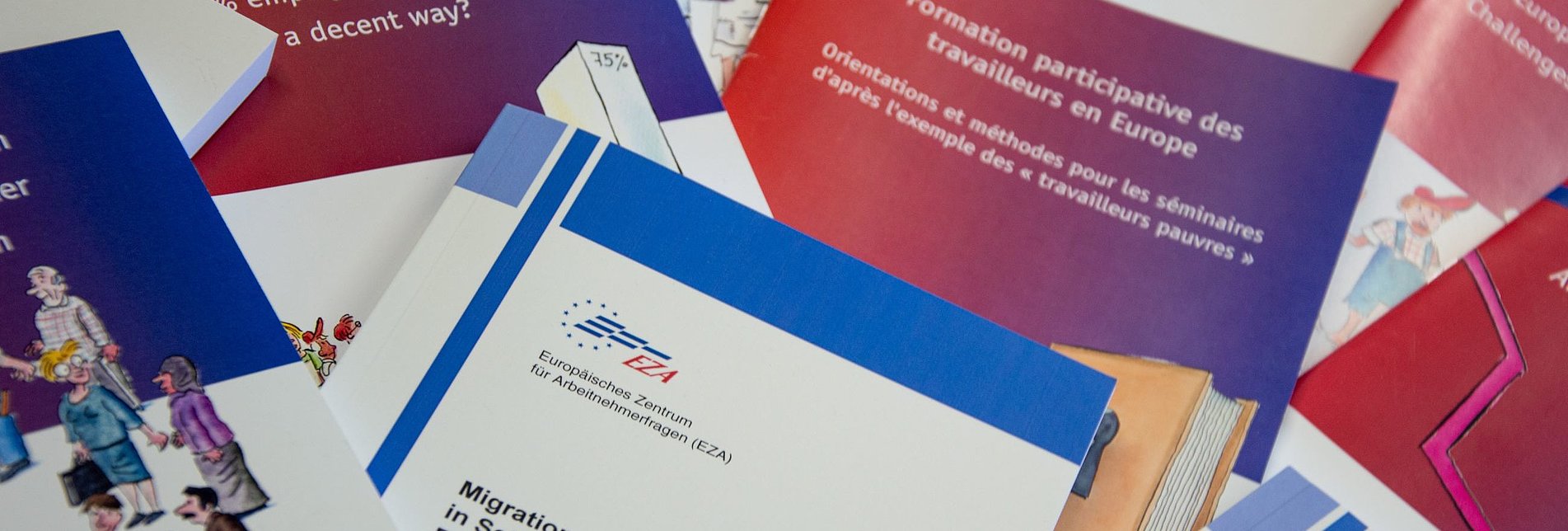
The FIDESTRA (Associação para a Formação, Investigação e Desenvolvimento Social dos Trabalhadores - Association for the Training, Research and Social Development of Workers) international seminar took place in Amarante (Portugal) from 25-28 September 2025, attended by 80 representatives from trade unions and other workers’ organisations from Portugal, Spain, Poland, Serbia, Bulgaria, France, Italy, Albania, Lithuania, North Macedonia and Germany. The theme of the seminar was “Challenges in qualifying labour in Europe: The skilled and unskilled work of displaced workers – Migrants and skilled work – challenges and opportunities”. The seminar was organised in collaboration with EZA and funded by the EU.
Challenges in the qualification of work in Europe – Europe in the future: skills, mobility and dignity in the workplace – Inequality between workers is increasing, and we are seeing changes in the labour market, future-oriented education and continuous, lifelong learning and significant and long-term structural shifts.
Problems arise regarding the recognition of the academic credentials of migrants, as their authenticity cannot be certified. They should therefore be granted the potential equivalence for the academic degree they hoped to acquire a priori in the country to which they were migrating.
Wage discrimination between locals and immigrants is groundless, even for similar jobs.
Migrants do not have access to the same job opportunities, and are forced to “settle” for precarious and unskilled jobs that are not compatible with their academic and professional qualifications.
This is a problem that affects all European countries that accept migrants.
The ageing population has triggered a huge requirement for immigrants, as they are generally young and contribute to increasing the birth rate, the sustainability of social security and to addressing the labour shortage.
Panel discussion 1 – Migrant workers – situations and motivations – Migrants face various difficulties, including workplace discrimination, precarious working conditions and language barriers. It is very difficult for migrants to find suitable work, because this barrier is not being lifted, and the credentials of migrants are often not equivalent to those of locals.
The motives for emigration and the choice of country are many: the importance of language and culture, work opportunities to improve the quality of life, an escape from poverty, improvement in social status, greater opportunities, family reasons (with all family members, partner and children), climate, conflicts/political persecution, and to live in a country that is less corrupt and has more stability and a lower crime rate. Migration can also take place after retirement for retirees who wish to live in a pleasant climate with a higher social standing.
Host countries should ensure that migrants are encouraged to learn the language when they arrive in the country, and receive certificates based on their language skills to overcome language barriers and avoid issues in the labour market.
Migrants reduce unemployment, while host countries gain more than they lose due to increased demographics and social systems; migrants also mitigate the effects of an ageing population.
Panel discussion 2 – Migrants in the labour market – challenges and contributions – It became clear that migrants are helped by mobility and that both skilled and unskilled workers are accepted into the host country. Immigrants who have entered the country legally and comply with the general rules of the destination country are well received. Unfortunately, in all European countries migrants may often receive extremely low wages, which are below those of local workers. The situation is even worse for migrant women, who receive even lower pay.
Panel discussion 3 – Further education and recognition of skills – The world is experiencing a massive transformation, technological innovation, economic growth, competitiveness, workplace competence and MO (Microsoft) certification. It is essential to reflect on the production process and review our learning models.
Panel discussion 4 – Inclusion and diversity in the workplace –
Migrants face several challenges, such as language and the selection of a country within Europe or a third country.
Serious discrimination exists against these people. Some countries serve as transit points only, even though they are democratic, such as Albania. Many young people, while still engaged in their studies, decide that they wish to emigrate to a specific country after graduation.
Women face high levels of discrimination. The joint integration policies across the EU are seriously addressing the barrier of discrimination.
Recommendations and suggestions – Working groups:
Increased funding for the psychological support of migrant workers/refugees, foundation of national agencies to tackle migration issues, with the National Agency as the supreme and highest authority to manage the reception of migrants in a specific country;
Standardisation and transparency of the criteria applicable in EU countries to obtain the right of residence – legalisation of residence status (clear and transparent criteria throughout the EU);
Standardisation of the system to recognise qualifications in EU countries – the recognition of a diploma/qualification in one EU country must be universal and applicable in other EU countries;
Standardisation of the procedural model for the reception of migrants/refugees in our countries;
Obligation for refugees/migrants to sign a declaration stating that they will comply with the laws of the host country;
More training for officials to ensure greater specialisation in the care of migrants;
Implementation of new technologies to simplify administrative processes;
The current process for assigning an identity and legalising asylum seekers is lengthy and too bureaucratic, which makes access to the labour market more difficult.
Challenges and opportunities for female migrants:
Migrant women face obstacles due to their migration status, challenges in the area of gender equality and the struggle to achieve a work-life balance.
Emphasis was placed on the need to create fair, just, productive and diverse working environments.
Inclusion goes beyond written guidelines: it refers to genuine equality and recognition.
Prejudices, unequal opportunities, and a lack of recognition persist. Women face larger gaps in terms of employment and wages.
Artificial intelligence offers both new opportunities (translation, teleworking) and risks, as it replaces typical entry-level jobs for migrants.
We must strive to achieve the actual implementation of inclusion and diversity policies.
Support from NGOs was, and is, crucial in terms of language lessons, vocational training, integration into the labour market, and legal and psychological advice.
Common psychological obstacles exist in the form of low self-esteem, lack of support networks, depression, burnout, and a reluctance to demand better working conditions.
Discrimination and prejudice still exist (e.g. accent, lack of language skills).
Comprehensive support initiatives (psychological, vocational, social), awareness campaigns and increased cooperation between public institutions and NGOs were recommended.
Inclusive practices in companies and administrations
Companies such as IQ Wiring Systems (Lithuania) have implemented mentoring programmes, training, translation of instructions, and cooperation with the Red Cross to facilitate the integration of Ukrainian female workers. They are an example that others can follow. They value the diversity of generations and the cooperation between generations as strengths in the workplace.
Collective agreements offer job security, equal rights and a voice in the union.
The promotion of cultural diversity through exchange programmes and international presence is key to competitiveness and creativity.
Administrative and linguistic barriers remain; public-private partnerships and training programmes are essential to achieve integration.
Shared perspectives and challenges:
Migration presents both a challenge and an opportunity for the labour market and society.
The challenges for migrants are similar in various European countries (discrimination, lack of government strategies, dependence on social initiatives).
It is important to see the individual stories and talents behind the data that enrich society.
Proposed measures:
Strengthen and implement specific measures for the professional integration of migrant women.
Expand the recognition of foreign qualifications beyond the health sector.
Improve psychological and social support, notably for migrant women who have partners or children.
Promote awareness campaigns to combat prejudice and discrimination.
Boost cooperation between government agencies, businesses and NGOs for genuine and effective integration.
Facilitate the learning of the host language and access to vocational training tailored to the requirements of the labour market.