
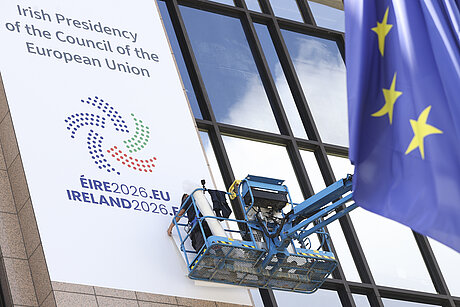
On 1 July 2026, Ireland assumed the rotating Presidency of the Council of the European Union for a six-month term. The Irish Presidency has organised its programme around three priorities: competitiveness, values and security. Under the competitiveness pillar, Ireland aims to advance the implementation of the One Europe, One Market Roadmap, which includes simplification measures (“omnibus” packages), initiatives to deepen the Single Market (such as the EU Inc. regulation and the revision of the public procurement directive), an ambitious trade policy agenda, and measures supporting Europe's digital and energy transition.
On values, Ireland emphasises continued EU support for Ukraine, the defence of democracy, the rule of law and fundamental rights, as well as efforts to promote peace in the Middle East and address the humanitarian situation in Gaza.
Under the security pillar, the Irish Presidency will seek progress on the forthcoming European Security Strategy, while advancing work on the measures set out in the White Paper on the Future of European Defence and the Defence Readiness Roadmap 2030.
Securing progress on the next Multiannual Financial Framework (MFF) 2028-2034 will be one of the most demanding tasks for Ireland. The dossier has already proven highly contentious, with the Danish and Cypriot Presidencies struggling to bridge the gap between the “frugal” Member States and the “Friends of Cohesion” over the size, priorities and financing of the future EU budget.
From a workers’ organisation’s perspective, two forthcoming initiatives deserve particular attention.
The first is the Fair Labour Mobility Package, expected to be published before the end of the year. The package will include a proposal on the European Social Security Pass (ESSPASS), aimed at facilitating the digital verification of social security rights across borders. Another proposal is expected to strengthen the mandate of the European Labour Authority (ELA), with the objective of improving the enforcement of fair working conditions and supporting a level playing field across the EU labour market.
The second is the Quality Jobs Act, which follows the 2025 Quality Jobs Roadmap. The initiative aims to update EU rules protecting workers while responding to technological, economic and societal changes. Although its final content remains to be seen, it is expected to address issues such as telework, the right to disconnect, algorithmic management, occupational safety and health, and subcontracting.
Beyond these flagship initiatives, Ireland has also pledged to support work on the new European Anti-Poverty Strategy, strengthen the European Child Guarantee, pursue measures to reduce the disability employment gap and advance the EU equality agenda. These files will be closely followed by trade unions and social organisations across Europe during the coming months.