

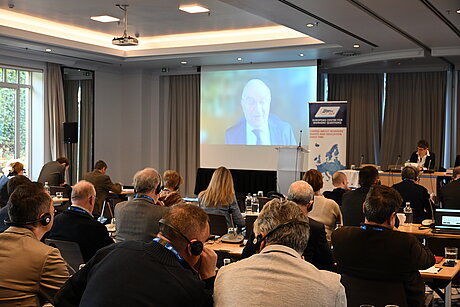
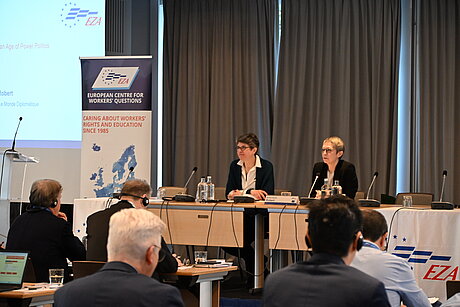
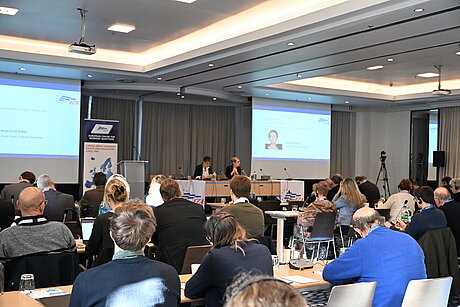
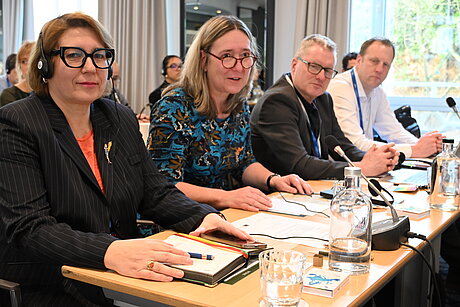
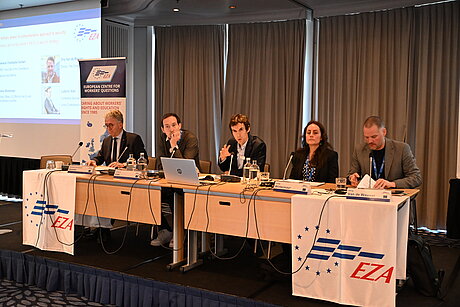
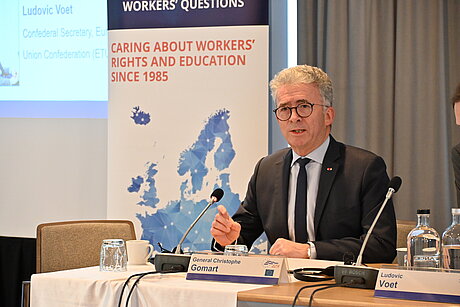
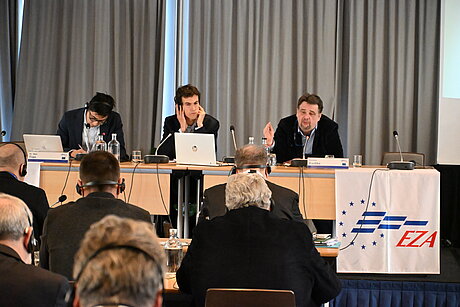
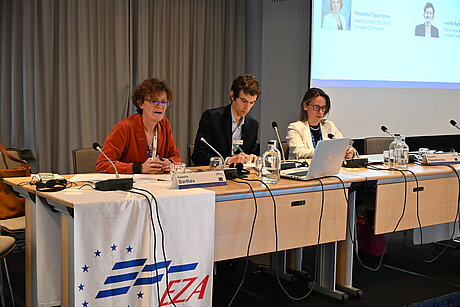
A series of historical cycles appear to be drawing to a close. The current international situation — marked by renewed geopolitical confrontation and multiple armed conflicts — is the result of these long-term structural developments rather than the personality of any single political leader, said Anne-Cécile Robert, keynote speaker. As a result, the European Union feels increasingly threatened, and defence policy has moved to the top of the EU’s political priorities.
Opening the conference, EZA President Luc Van den Brande stressed that Europe must respond to this new reality without abandoning its core principles: “Europe in essence is and will remain a peace project”. It was against this backdrop that the 2026 EZA Conference in Brussels brought together trade unions, political representatives, academics and participants from 21 countries to reflect on the social implications of this new “security turn”.
Security beyond the military dimension
The first panel addressed a fundamental question: how can the EU’s evolving security policy remain compatible with its commitment to peace — and with the values of a network of Christian workers’ movements?
Participants acknowledged the deterioration of the international context, the challenges it poses for Europe, and the need to ensure that the Union can rely on a credible and effective military deterrence. At the same time, they emphasised that defence should be understood as one pillar of a broader and comprehensive security strategy, not as its sole foundation. Military capabilities may be necessary, but they are not sufficient to ensure lasting peace.
In a period marked by fiscal constraints across many Member States, speakers warned against a narrow understanding of security that would crowd out other essential instruments. Diplomacy, international cooperation and development policy, multilateralism and social justice are not secondary or optional; they contribute directly to stability and peace. These dimensions do not follow military policy — they must advance alongside it.
In this context, participants stressed the importance of consistently upholding international law and strengthening political and financial support for the United Nations system. At the same time, they recognised the limits of the current multilateral architecture and the need for reforms to enhance its effectiveness.
The social and economic trade-offs of rearmament
The second panel examined the social and economic consequences of rising military expenditure.
Increasing defence spending is a legitimate political decision which should be driven by strategic considerations. In this regard, economic return should not be the decisive criterion when making such a choice. However, the budgetary and macroeconomic implications of higher defence spending cannot be ignored. If the political decision is made to raise defence budgets, three elements should be clearly acknowledged:
- Higher defence expenditure always entails trade-offs. Public resources are limited, even in times of exceptional borrowing or temporary fiscal flexibility.
- Evidence suggests that defence spending tends to have a much lower impact on economic growth (the so-called “fiscal multiplicator) compared to other categories of public investment, such as infrastructure, education or social services.
- Significant inefficiencies persist in the allocation of defence resources, linked to the structure of the sector, procurement rules, and shortcomings in accountability and transparency in budgetary decision-making.
From the perspective of workers’ organisations, these factors are not abstract considerations. They directly affect employment patterns, public services, social cohesion and the long-term orientation of European economies.
The Defence Readiness Omnibus and Europe’s industrial base
The third panel turned to the Defence Readiness Omnibus and to the broader weaknesses of the European defence industry.
The Omnibus aims to accelerate defence preparedness by simplifying procedures and removing regulatory obstacles for companies. While such measures may improve short-term responsiveness, participants noted that regulatory simplification alone will not resolve the structural challenges facing the EU’s industrial base.
These include fragmentation between national markets, underinvestment, duplication of capacities and the absence of fully integrated European supply chains. Ensuring industrial sovereignty in the defence sector requires long-term coordination, political will and, above all, trust between Member States.
At the same time, discussions highlighted the importance of safeguarding labour standards and workers’ rights within this evolving framework. Speed and simplification should not come at the expense of social protections.
A continuing debate
The conference made clear that the EU’s security turn raises complex and far-reaching questions. For trade unions and Christian workers’ organisations, the challenge is not to deny the new geopolitical reality, but to engage with it critically and constructively — ensuring that security policy remains anchored in peace, solidarity and human dignity.
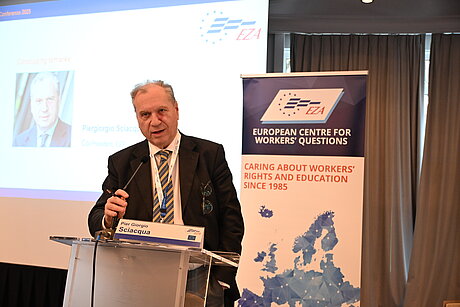
In his concluding remarks, EZA Co-President Piergiorgio Sciacqua recalled the words of Pope Paul VI: “Development is the new name for peace.” The reference echoed a central theme of the conference discussions — that security policy and social justice cannot be separated if Europe wishes to build a lasting and sustainable peace.
A more detailed report of the conference discussions will follow. The topic will also be explored further in EZA Magazine 01/2026, which will examine additional perspectives and contributions.