

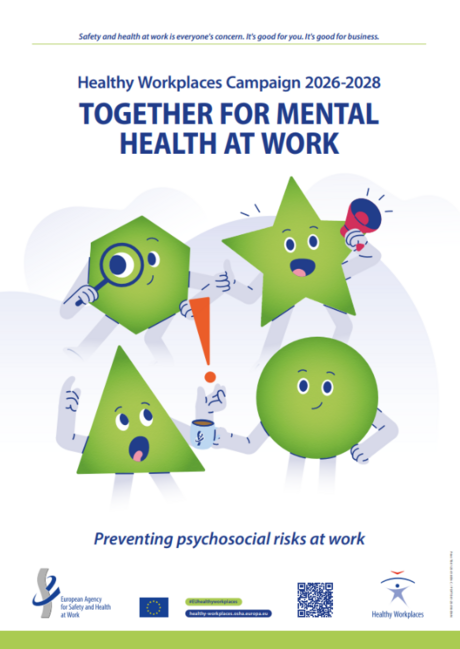
EZA is a campaign partner of the European Agency for Safety and Health at Work (EU-OSHA)’s Healthy Workplaces Campaign 2026–2028: Together for Mental Health at Work. Running until 2028, the campaign aims to raise awareness of psychosocial risks and promote practical solutions to protect mental health at work. Through tools, training, events and the exchange of good practices, it seeks to help employers, workers and their representatives create healthier working environments.
Mental health at work is a significant challenge across Europe. According to EU-OSHA, 29% of EU workers reported in 2025 that their work caused or worsened stress, depression or anxiety. Excessive workloads, job insecurity, poor work organisation, harassment and the growing impact of digital technologies can all contribute to psychosocial risks. Addressing these risks therefore requires more than individual support: it calls for effective prevention and action on working conditions.
On 6 October 2026, the European Parliament adopted a resolution on psychosocial risks, stress and mental health at work, calling on the European Commission to propose stronger EU legislation. While existing EU rules already require employers to protect workers’ health and safety, there is no comprehensive European framework setting out common requirements specifically for preventing psychosocial risks. National approaches differ, leaving workers with uneven levels of protection across the EU.
Parliament’s recommendations cover several areas. They call for clear definitions of psychosocial risks and stronger obligations for employers to assess and prevent them. They also seek better recognition of work-related health conditions, including burnout, stronger labour inspectorates, improved data collection and support for workers returning after sickness absence. The resolution further emphasises the involvement of workers and their representatives in prevention, as well as effective measures against workplace violence, harassment and bullying.
The next step lies with the European Commission. Mental health should be one of the main issues addressed in the upcoming Quality Jobs Act, expected in late 2026. This would be an opportunity to strengthen the protection of workers’ mental health and establish clearer European standards for preventing psychosocial risks. As digitalisation and artificial intelligence continue to transform the organisation of work, it will be essential to ensure that these changes do not come at the expense of workers’ health and wellbeing.