

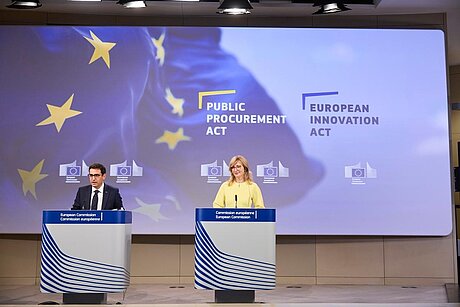
Building a motorway, equipping schools, cleaning a public building… Every year, public authorities across the EU launch tenders worth around €2.5 trillion for works, goods and services, representing approximately 15 per cent of the EU’s GDP. Once certain thresholds are reached, EU public procurement rules apply, with the aim of ensuring transparent and fair procedures, as well as fair competition between companies.
One of the goals of the revision is to make public procurement a tool for achieving strategic objectives. Public money should contribute to advancing innovation, security and resilience in the EU, while also supporting environmental and social goals. And this is where the issue becomes particularly relevant for workers: by choosing their suppliers, public authorities have significant leverage to promote better social practices and working conditions.
Quite radically, the Commission proposes replacing the three existing directives with a single regulation, the Public Procurement Act, which would also have a broader scope. Unlike directives, a regulation applies directly across the EU, reducing national discretion and aiming for greater uniformity. The risk is, as the European Trade Union Confederation (ETUC) points out, that greater harmonisation could reduce the scope for Member States and regions to pursue more ambitious social procurement policies. The new framework should therefore safeguard their ability to go beyond minimum European standards on employment, working conditions and collective bargaining.
The regulation would also bring together the rules on concessions and the sectors currently covered by the so-called “utilities directive”, notably water, energy, transport and postal services. While the Commission presents this as a simplification measure, public service trade unions fear that sectors with specific characteristics could lose some of the special treatment they currently enjoy. This is particularly sensitive in the water sector, where unions have traditionally opposed measures that could encourage privatisation or increased reliance on concessions and competitive tendering. According to unions, water services should remain under democratic control and be assessed primarily according to their social value rather than market considerations.
The proposal also seeks to move away from the widespread practice of awarding contracts primarily on the basis of the lowest price. As a general rule, contracts should instead be awarded on the basis of the “best price-quality ratio”. The proposal requires quality criteria to account for at least 30 per cent of the evaluation score, rising to 50 per cent for labour-intensive contracts. These criteria may include social, environmental and innovation-related considerations. The quality of the conditions under which a good or service is produced could therefore carry greater weight in the award of a contract.
For trade unions, this is one of the key issues at stake in the reform. The proposal explicitly highlights social objectives such as improved working conditions, upskilling and reskilling of workers, gender equality, social inclusion and respect for human rights throughout supply chains. It also recognises the role of collective bargaining. However, the proposal does not require companies bidding for public contracts to be covered by a collective agreement, a goal that the European services union UNI Europa has long campaigned for. It does, however, allow public authorities to take collective bargaining and other social considerations into account when evaluating bids and selecting the winning contractor.
Subcontracting is another important issue. The proposal prohibits full subcontracting and introduces greater transparency requirements, but it does not establish a general limit on the number of subcontracting levels. As the European Federation of Building and Woodworkers (EFBWW) recalls, the absence of a limit on subcontracting levels is particularly problematic in the construction sector, where long subcontracting chains are common.
Finally, mechanisms for European preference represent another important innovation, with potentially significant implications for jobs and employment. The proposal allows, under certain conditions, public buyers to favour European operators, goods, services or works through participation restrictions, minimum European-origin requirements or evaluation preferences. It also provides for the possibility of excluding certain tenders in specific circumstances linked to origin requirements. Public procurement thus becomes more explicitly an instrument of industrial policy, economic security and strategic autonomy.
The very concept of public procurement is at stake in this reform: should it merely enable public authorities to purchase goods and services at the best price, or can it also serve broader economic, social, environmental and strategic objectives? With €2.5 trillion at stake every year, the potential impact on the economy and employment is considerable. This is a debate that trade unions will need to follow very closely.
Resources on the revision of the public procurement directive on UNI Europa’s website