
Companies operating across several Member States benefit from the EU single market rules. These allow them to provide goods and services across borders, as well as to set up and operate in other Member States just as local companies do.
However, firms wishing to expand into other Member States still need to navigate different national legal systems. For example, a company incorporated in Latvia that expands into Germany and Portugal typically does so by creating subsidiaries or branches (e.g. a German GmbH or a Portuguese Lda) governed respectively by German and Portuguese company law.
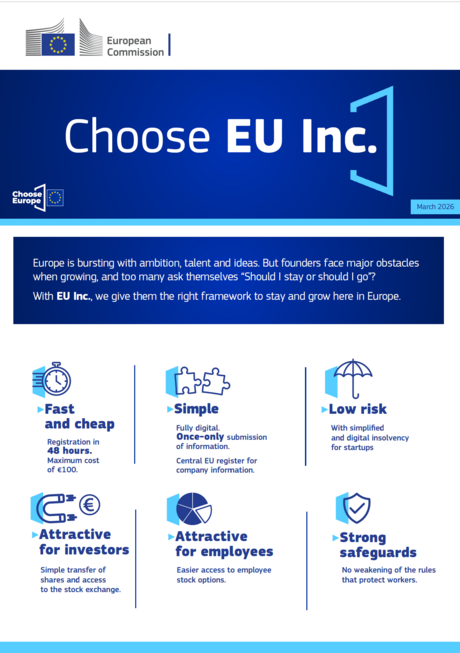
To further reduce this legal fragmentation, the Commission proposed in March 2026 a new EU-wide corporate form for “innovative companies”, complemented by a set of harmonised corporate rules governing key aspects of company formation and operation. This “28th legal regime” would coexist alongside the 27 existing national company law systems.
The proposal thus establishes a new legal framework for so-called “EU Inc.” companies covering their entire lifecycle. It defines how such companies are created (through a fast, fully digital registration process), how they can operate and expand across the EU without setting up separate national companies, and how their internal governance is structured, including rules on directors and decision-making. It also sets common rules for their dissolution, ensuring a uniform procedure for winding up the company across all Member States. For all matters not explicitly regulated at EU level by this Regulation, EU Inc. companies would still have to comply with many national rules in the countries where they operate, notably in areas such as labour law, taxation and social security.
A practical example: instead of creating a separate German company in Germany and a separate Portuguese company in Portugal, the Latvian company mentioned above could create a single “EU Inc.” company in one EU Member State through an online registration procedure. This same company could then open offices, hire employees, sell services or develop activities in several EU countries while keeping the same legal form and largely the same corporate rules everywhere in the EU.
While the business community generally welcomed this new initiative, unions fear that the proposal could allow companies to organise themselves across borders in order to benefit from weaker regulatory or labour protection regimes in certain Member States, a dynamic often described as regulatory arbitrage or “forum shopping”.
This concern is further increased by the fact that this new regime is not strictly limited to genuine start-ups or scale-ups, increasing the risk that other firms use the EU Inc. form only to bypass stricter national rules on labour relations and corporate governance.
The very fast registration procedure raises further concerns about insufficient scrutiny by national authorities. Such speed could make it more difficult to detect the creation of artificial or abusive corporate structures, thereby facilitating the establishment of letterbox companies and reinforcing the risks of regulatory avoidance.
Another concern relates to employee participation rights of EU Inc. companies, which would depend on the Member State where the EU Inc. is registered. Since companies would be free to choose their place of registration, this could create incentives to establish the legal seat in jurisdictions with less developed systems of worker involvement.
The proposal now enters negotiations between the Parliament and the Council, where the balance between simplifying cross-border business activity and protecting workers’ rights is likely to become one of the central points of debate.