

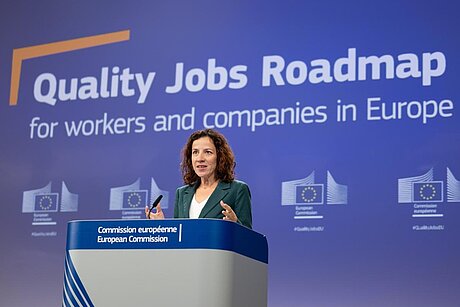
The Quality Jobs Roadmap presented by the European Commission on the 4th of December 2025 outlines a strategic framework to place job quality at the centre of the EU’s economic and social model. Conceived as a preparatory step towards a future Quality Jobs Act, the Roadmap links employment quality directly to competitiveness, productivity and social cohesion. It responds to structural challenges such as skills shortages, digitalisation, demographic change and the green transition, arguing that sustainable growth in Europe depends on fair wages, secure employment and strong worker protection.
The Roadmap sets out a comprehensive policy agenda structured around several core dimensions of job quality. It addresses fair wages and adequate minimum income, secure and predictable employment relationships, safe and healthy working environments, access to social protection, and effective worker representation through social dialogue and collective bargaining. It also covers fair labour mobility, equal treatment for mobile and third-country workers, and improved enforcement of labour law across Member States. In addition, the document highlights the need to better anticipate economic change, including restructuring processes, by strengthening worker involvement and ensuring just transitions when jobs are transformed or lost.
The Roadmap further details how quality jobs should be supported through investment, skills policies and regulation in the context of the green and digital transitions. It promotes lifelong learning, upskilling and reskilling as central tools to help workers adapt to technological change and industrial transformation, while encouraging higher participation of women and older workers in the labour market. Digitalisation and artificial intelligence are addressed with a focus on safeguarding fundamental rights at work, including transparency, data protection and occupational safety. Public procurement, EU funding instruments and revised state aid rules are identified as levers to promote quality employment, while a future crisis-response mechanism is envisaged to protect jobs and incomes during major economic shocks.
While the Roadmap outlines a broad and coherent vision, it remains a strategic document without binding force. Several critical observers point out that many of its commitments reiterate existing EU objectives without clearly specifying new rights, concrete benchmarks or enforcement mechanisms. Trade union and civil society voices warn that an excessive emphasis on competitiveness and flexibility risks diluting the social ambition of quality jobs, particularly if regulatory simplification leads to weaker labour protections. Others underline that the absence of a clear, operational definition of “job quality” may hinder effective monitoring and accountability. The credibility of the Roadmap will therefore depend on whether the forthcoming Quality Jobs Act delivers precise, enforceable standards, backed by sufficient investment and a genuine commitment from Member States to translate principles into measurable improvements in working conditions.