

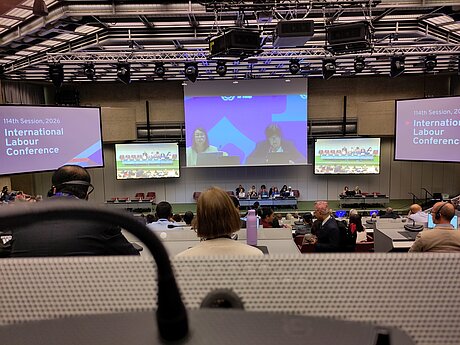
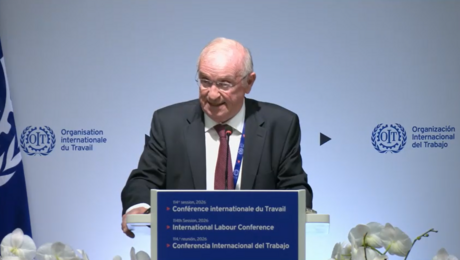
"Dear Mr. President, Vice-Presidents and Delegates:
On behalf of the European Centre for Workers' Questions (EZA), representing 71 workers’ organisations in 30 countries, we take pleasure in contributing our experience and insights from our educational and research work on social dialogue in Europe to the invaluable work of the ILO.
For an increasing number of people worldwide, technological change and the use of AI are a tangible reality of everyday life and everyday work.
For older workers, appropriate forms of transition and up- or reskilling will be needed. For generation Z the question arises as to how they will still gain access to the labour market despite good skills and AI literacy, avoiding a supplementary divide.
It is important to demystify AI, to exploit its undeniable advantage and at the same time to clearly enclose the associated risks with appropriate regulations. I therefore fully agree with the analysis and conclusions of the report by the Director-General of the ILO: a people-centred approach is needed, one that prioritises labour rights for workers, employment, social protection and social dialogue when it comes to shaping a regulatory framework.
We need a trustworthy, explainable, transparent AI for preserving and expanding human autonomy, empowering and helping people to make better decisions, while respecting ethical standards.
With robotics and AI, the risk of loss of jobs is greater than ever. Alignment problems are to be solved: bottom-up, built by the global community not by single companies, strengthening international cooperation to make AI also open source and generative by law. Human centric and not machine centric, as a tool for empowerment not of replacement, as an extension of the human user.
In an emerging new world order where solidarity is giving way to the self-interest of autocrats and technocrats who want to undermine democracy, ignoring international rules, the role of tech giants needs to be addressed. They must not overrule tripartism as a fourth decisive actor. They are to be taken responsible and accountable in a representative social dialogue. To ensure that AI is used for the benefit of all, I would like to state it explicitly: EZA stands by international cooperation and its institutions. The United Nations as a whole and the ILO in particular are of great importance for decent work, sustainable prosperity and socially just distribution of wealth - ensuring that AI serves the common good.
Pope Leo XIV states in his encyclical ‘Magnifica Humanitas on safeguarding the human person in the time of artificial intelligence’: “International organizations, particularly the United Nations, are essential instruments for promoting a civilization of love, for they can foster dialogue among nations and promote the peaceful resolution of conflicts, the integral development of peoples, the protection of the most vulnerable, disarmament and the care of creation. Through such efforts, the international community can work to reduce inequalities, defend the rights of refugees and minorities, reallocate resources from military spending to human development and protect our common home.” The role of the UN and ILO cannot be put into words more aptly than Pope Leo XIV did.
To this end, we must also be clear “that economic freedom is not absolute; it must always be measured against the common good and the dignity of every person”, as Pope Leo states. This call is not only addressed to legislative bodies and companies providing AI, but also to every single user of AI. ‘Disarming’ AI, is the responsibility of all of us.
In these challenging times, EZA, together with the ILO, is committed to accompanying and shaping the profound changes in the world of work that accompany the opportunities and risks of artificial intelligence for workers.
Thank you for your attention."