

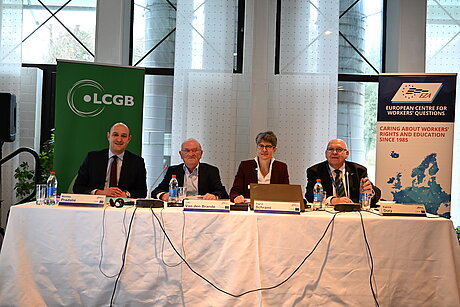
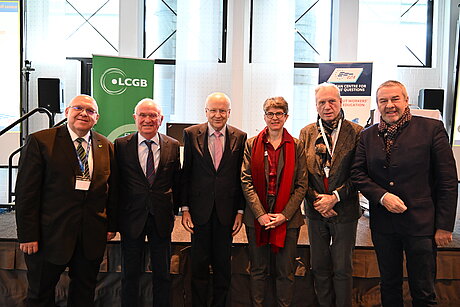
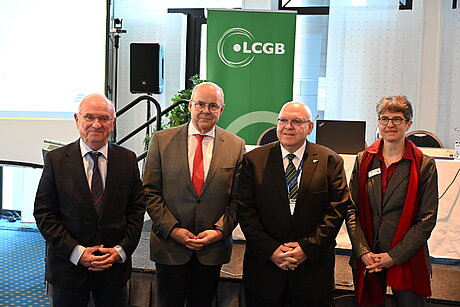
Together with the Luxembourg Christian Trade Union Confederation (LCGB), we at the European Centre for Labour Issues (EZA) have successfully concluded this year’s kick-off seminar in Luxembourg. With high-profile guests from European institutions, politics, trade unions and academia, we discussed the future of social dialogue in Europe, the role of the European institutions and the impact of technological change on the world of work.
The importance of a functioning social dialogue, particularly in politically and socially challenging times, was already made clear during our opening session. Our Chair, Luc Van den Brande, emphasised that, especially in difficult times, a space is needed in which conflicts are not suppressed but can be resolved for the benefit of all those involved. At the same time, he expressed concern that social issues might lose prominence on the European Commission’s current political agenda.
Patrick Dury, President of the LCGB, also underlined the importance of social dialogue as an essential component of Europe’s success story. He noted that networks such as EZA are particularly important in light of the current challenges.
Nicolas Pradalié, Head of the Social Dialogue Unit in the European Commission’s Directorate-General for Employment, Social Affairs and Inclusion, highlighted the Commission’s commitment. As examples, he cited the 2025 Pact for European Social Dialogue, the Commission’s 2027 work programme with its social dimension, and the planned ‘Quality Jobs Act’.
European perspectives on workers’ rights and social partnership
Prof. Dr Koen Lenaerts, President of the Court of Justice of the European Union, provided an important European perspective. He examined the development of European case law in labour and social law and emphasised the Court’s central role in ensuring the effectiveness of the social rights enshrined in EU law and their implementation in the Member States. In this way, European case law makes an important contribution to the protection of workers’ rights.
„It is the interaction between the political and the judicial process that moves workers rights forward”
In our panel discussions, we examined national experiences of social dialogue and the role of European law. Michael Schediwy-Klusek, General Secretary of the FCG-GPA, provided insights into the Austrian model and emphasised the need for a modern social dialogue that puts people at the centre.
Jane Heitmann, Chair of the Danish trade union KRIFA, drew attention to the challenges facing trade union freedom of choice in Denmark. She stressed that workers’ right to decide for themselves how their interests are represented must be safeguarded.
Luxembourg and the importance of cross-border cooperation
Marc Spautz, Minister for Labour of the Grand Duchy of Luxembourg, provided insights into the specific characteristics of the Luxembourg labour market. He noted that this market is strongly influenced by the Greater Region. Around 250,000 cross-border workers are of great importance to the Luxembourg economy. Cross-border coordination and cooperation with Germany, Belgium and France, as well as coordination at European level, are therefore crucial.
At the same time, the Minister for Labour called for greater emphasis to be placed not only on the challenges facing the European Union but also on its achievements. These include, in particular, the single market and open borders, which have a decisive influence on everyday life and economic cooperation in Europe.
Artificial Intelligence: Shaping technological progress in a socially responsible way
We addressed a key issue for the future: the impact of artificial intelligence on the world of work. Birte Dedden, Head of the Information, Communication, Technology and Services (ICTS) division at UNI Europa, outlined the possibilities offered by collective bargaining agreements regarding the use of AI in the workplace. Given their flexibility, collective bargaining agreements could serve as an important complement to European legislation.
Lubor Lacina, Vice-President of KAP – the Christian Workers’ Movement of the Czech Republic – highlighted the social and economic challenges posed by the rapid development of AI. He argued that Europe must reconcile economic competitiveness with social rights and solidarity. In particular, the implications for employment, income distribution and human dignity must be taken into account.
Referring to the social encyclicals ‘Rerum Novarum’ and ‘Magnifica Humanitas’, Lacina set out a key guiding principle: technology must serve people and must not replace their fundamental role in society. Technological progress must safeguard decent work and social protection and benefit society as a whole.
The perspectives of younger workers were also part of our discussions. Thomas Capone, a representative of the National Union of Immigrant and Emigrant Associations (UNAIE) on our EZA Platform for Young Workers (PYW), and Maria Petrova, head of the PODKREPA vocational training centre and chair of the PODKREPA Youth Network, shared their experiences.
Strengthening social dialogue in Europe together
Our kick-off seminar has once again demonstrated the importance of European dialogue between trade unions, policy-makers, European institutions and civil society actors. The diverse perspectives have highlighted that the challenges facing the world of work require joint European responses.