

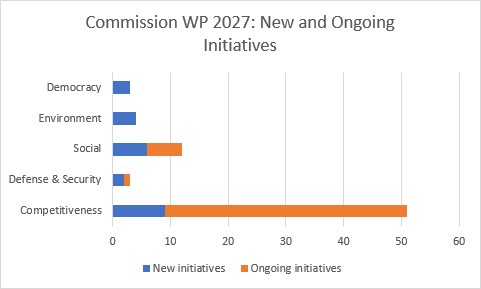
‘European Union – standing up for one another’ – this is the title of the Work Programme for 2027, which the European Commission presented in November. Against a backdrop of geopolitical uncertainties, economic challenges and rapid technological change, the Commission is focusing on strengthening Europe’s competitiveness, strategic autonomy, economic resilience and security. The programme comprises 23 new initiatives, with a particular emphasis on implementing existing commitments, reducing bureaucratic requirements and simplifying EU legislation. Although Europe’s social dimension is also part of the programme, it plays a rather subordinate role.
The numerous initiatives contained in the work programme aimed at simplifying existing legislation deserve particular attention. The Commission is continuing on its current course with further omnibus packages and measures to cut red tape. Another key forthcoming legislative initiative is ‘EU Inc.’, which aims to create a uniform European legal framework for businesses. The Commission’s proposals also include a ‘Pact against Gold-Plating’, designed to prevent Member States from introducing additional national requirements when transposing European legislation. These initiatives should be closely monitored; simplification and the reduction of red tape must not come at the expense of social achievements or result in the weakening of workers’ rights, social protection standards or the enforcement of existing regulations.
The work programme also includes a number of initiatives of direct relevance to workers.
Education is described in the work programme as the ‘EU’s most valuable resource’, and the Commission plans to present a ‘Skills Guarantee’ in the third quarter of 2027, partly in light of the impact of digitalisation and artificial intelligence on the labour market. Workers in sectors undergoing structural change are to be supported through targeted further training and reskilling, thereby facilitating their access to new employment opportunities in strategic sectors. Pilot projects, including some for workers in the automotive industry, are already underway; it remains to be seen whether this will truly result in an effective instrument that offers workers secure career prospects.
Further planned initiatives include the ‘European Care Deal’, which is expected in the second quarter of 2027 and is intended to help improve the provision of care. The initiative aims to promote affordable, high-quality care services and help address staff shortages in the care sector, including through better working conditions and career development opportunities for care workers. The “Strategy on the Right to Stay” is intended to support people in regions particularly affected by population decline and economic stagnation in building a future in their home regions. A summit on this topic has also been announced for next year to mark the tenth anniversary of the European Pillar of Social Rights, although no further details have been provided.
Overall, the 2027 Work Programme sets out an ambitious agenda for Europe with a clear political focus: competitiveness and simplification are at the forefront, whilst, although some social initiatives have been announced, many of them remain rather vague. As the Commission concludes: “Europe will only be stronger if we work together at different levels and across borders. The time to deliver on our independence is now.”
The European Commission’s Work Programme for 2027 and further information can be found here: https://commission.europa.eu/publications/2027-commission-work-programme-and-annexes_en